Note: This article was originally published by The Post. See the full article here.
By Esther Robinson, political commentator and Director of Government Relations at One Plus One Communications
Thirty years after adopting MMP, New Zealand has learnt to vote under a proportional system. We have not fully learnt to campaign, or talk about political power, under one.
The 2026 election will be our eleventh under MMP. Voters will not directly elect a prime minister. We will elect a Parliament, and the government will be formed by whoever can command the confidence of a majority in that Parliament, usually through coalition or support agreements.
Yet elections are still narrated as ‘presidential-style’ contests between the National and Labour leaders. Preferred-prime-minister polls, leaders’ debates, campaign advertising and daily political coverage place one person at the centre of each party’s offer.
The shortcoming of this approach becomes particularly clear whenever a major party faces a leadership challenge, as recent questions over Christopher Luxon’s leadership have illustrated.
When a party’s political identity is concentrated in one individual, replacing that individual can look like the fastest route to renewal. A leadership change can create energy and shift how voters see a party. But under MMP, replacing a prime minister is not simply a personnel change. It can unsettle the coalition arrangement through which voters’ party choices were translated into government. A new leader may offer a fresh face, but they inherit the same coalition arithmetic and governing record.
Successful leadership under MMP is no mean feat. It is less a solo performance than conducting an orchestra: each party must retain its own voice and satisfy its own supporters, while the prime minister must turn those competing mandates into a coherent government. The best MMP leaders are therefore not simply the strongest campaigners. They are those who can do the coalition maths, negotiate a credible governing arrangement and manage it competently once the election is over.
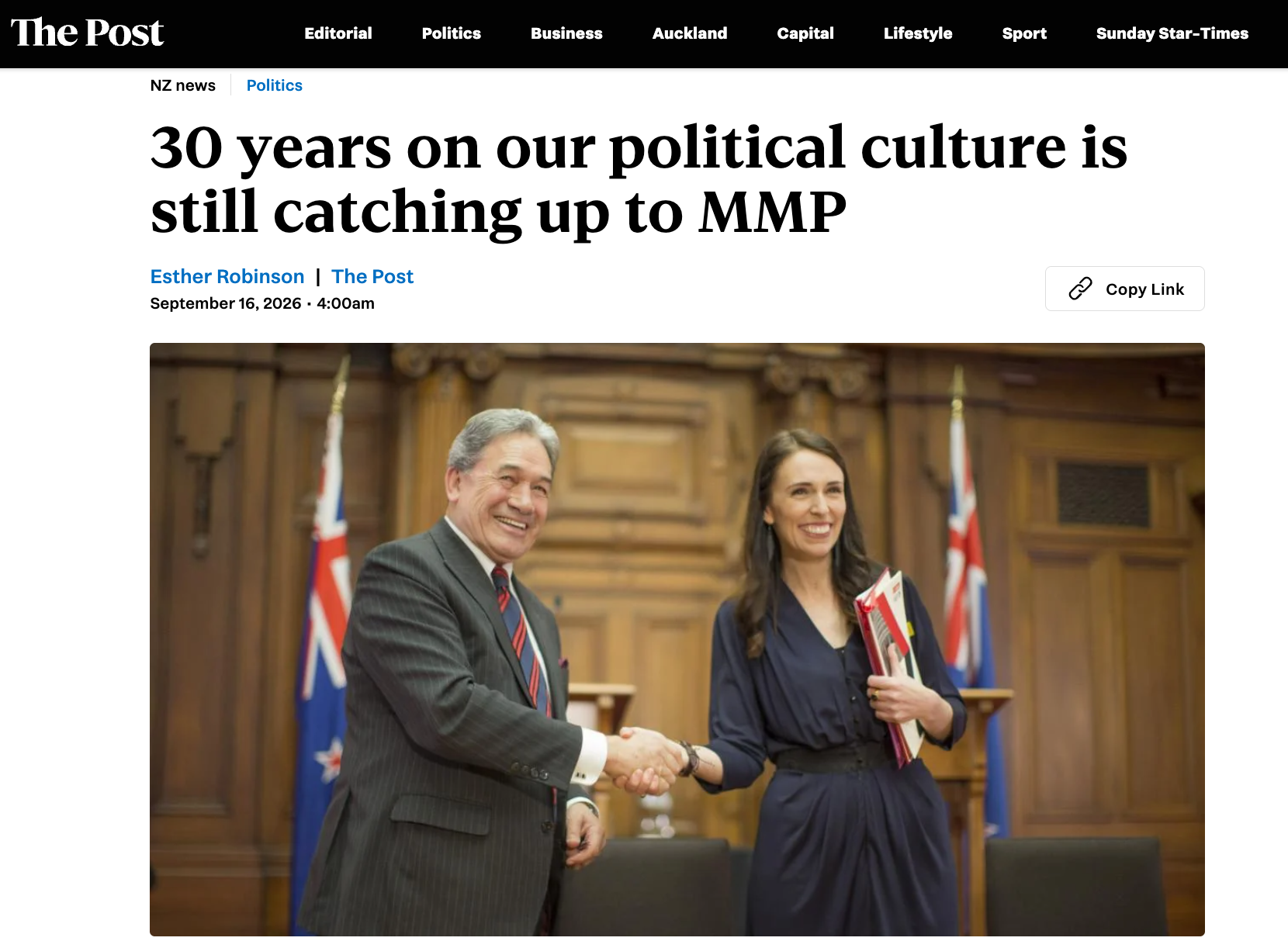
The example repeatedly raised by those advocating change recently was Andrew Little’s replacement by Jacinda Ardern in 2017. It is an example of strong leadership being instrumental in connecting with voters, as Ardern transformed Labour’s prospects within weeks.
But the eventual formation of government demonstrates the more important MMP lesson. National won the largest share of the vote and the most seats. Labour formed the government because Ardern could assemble a parliamentary majority with New Zealand First and the Greens.
Voters did not directly elect a prime minister. They elected a Parliament from which a government could be formed.
MMP is not flawless. It can blur accountability, give smaller parties significant leverage and make it harder for a governing party to implement a completely coherent programme. But coalition negotiation is not a glitch in the system. It is how the preferences expressed by voters are converted into a government.
New Zealand should not conclude from recent leadership debates that leaders do not matter. They matter enormously in determining electoral success. But successful leadership under MMP should be assessed through the lens of the ability to build relationships, manage competing mandates and sustain the confidence of both Parliament and the public.
A more mature MMP politics would judge not only the two major-party leaders, but the strength of their teams, the credibility of their coalition options and their ability to turn competing electoral mandates into stable government.
As voter support disperses across more parties, the label “minor party” may itself become outdated. Coalition partners could agree that the leader of a smaller party should become prime minister, provided the resulting government commanded the confidence of the House.
Strategists have also long floated major parties and aligned offshoots dividing the two votes between them - party vote for one, electorate vote for the other-to engineer overhang seats. Whether voters would tolerate such gaming is another matter, but MMP will not necessarily remain a two-party contest with supporting players.
We adopted MMP 30 years ago. The next stage in its development is for our political culture, and our election campaigns, to catch up.